As I get older, I of course think everything was better back in my day (kidding). One thing I often think about is old pixel art games. I have a deep love of pixel art. I think it should be as recognized as pointillism, impressionism, etc. One thing I love about pixel art in 2d games is it leaves something open to the imagination. As a player, it was like you were being told the rough outline of the world. Characters often only had a few lines of text they would say. Maybe I just had an active imagination.
Modern games often push for realism, building bigger worlds with finer details and total immersion. But when everything is fully rendered in high-definition 3D, it leaves far less for the imagination to fill in.
Knowing You’re Not the Only One
For all the negative things the internet has brought with divisiveness, hatred, and attention-seeking, there’s been another side I’ve seen. The internet can also be affirming that there are other people in the world who see it the way you do, the way you feel it, and appreciate the small things you appreciate. (This will come back around to pixel art, I promise.)
This brings me to Final Fantasy VI.1 Final Fantasy VI was a landmark game for me when I played it. It was an epic with a diverse cast of characters, each with their own musical motifs and a score that is so majestic it still brings wonder that it fits on that game cartridge. And even though each character is only about 16 x 24 pixels big, you can still see characters emote and animate. It seems so simplistic now. It’s a game that deals with death, loss, and hopelessness. Now, this may be stupid and a small, trite thing, but there was a character in that game named Shadow. Shadow was a ninja, but I saw his sprite as a dark skinned man with a bandana (even though on the character stats screen he was shown with a more detailed portrait in the style of Yoshitaka Amano’s art). Later, I saw more artwork of the character and was like, oh, wow, how wrong was I with my imagination. Until one day, deep in the depths of Reddit, I came across a subreddit named MisreadSprites. It was dedicated to pixel artwork sprites and how people interpreted or imagined characters or creatures in games compared to the artist’s intent. And lo and behold, someone else had imagined Shadow the same way I did. I know it’s dumb, but that little moment reassured me in more than one way that we all see the world differently, but there’s probably some person out there who sees what you see.
Leaving Room to Fill in the Blanks
Back to old games. I still love 2D games and how they give the player room to fill in the blanks of the world. This goes to movies and books, too. Sometimes the less told or less explained leaves room for the mind to play and explore. People still talk about the ending of Inception. The first John Wick was fantastic in depicting some weird underworld of assassins with their own currency, government, and economy. Then we have things like The Legend of Zelda: a series of games that’s lasted 40 years. They often contain similar elements, locations, and characters. The true intent of The Legend of Zelda is that the stories are passed down for generations with differences and influences changing the narrative each time they are told. They are mythology. They are that story from your crazy uncle about that time he fought some thugs off, but each time he tells it, there are more thugs and more heroics. Imagination is fun, but sometimes it can be spoiled by rules. An example would be when Nintendo published Hyrule Historia in 2011, establishing an official timeline split across three branches following Ocarina of Time.2
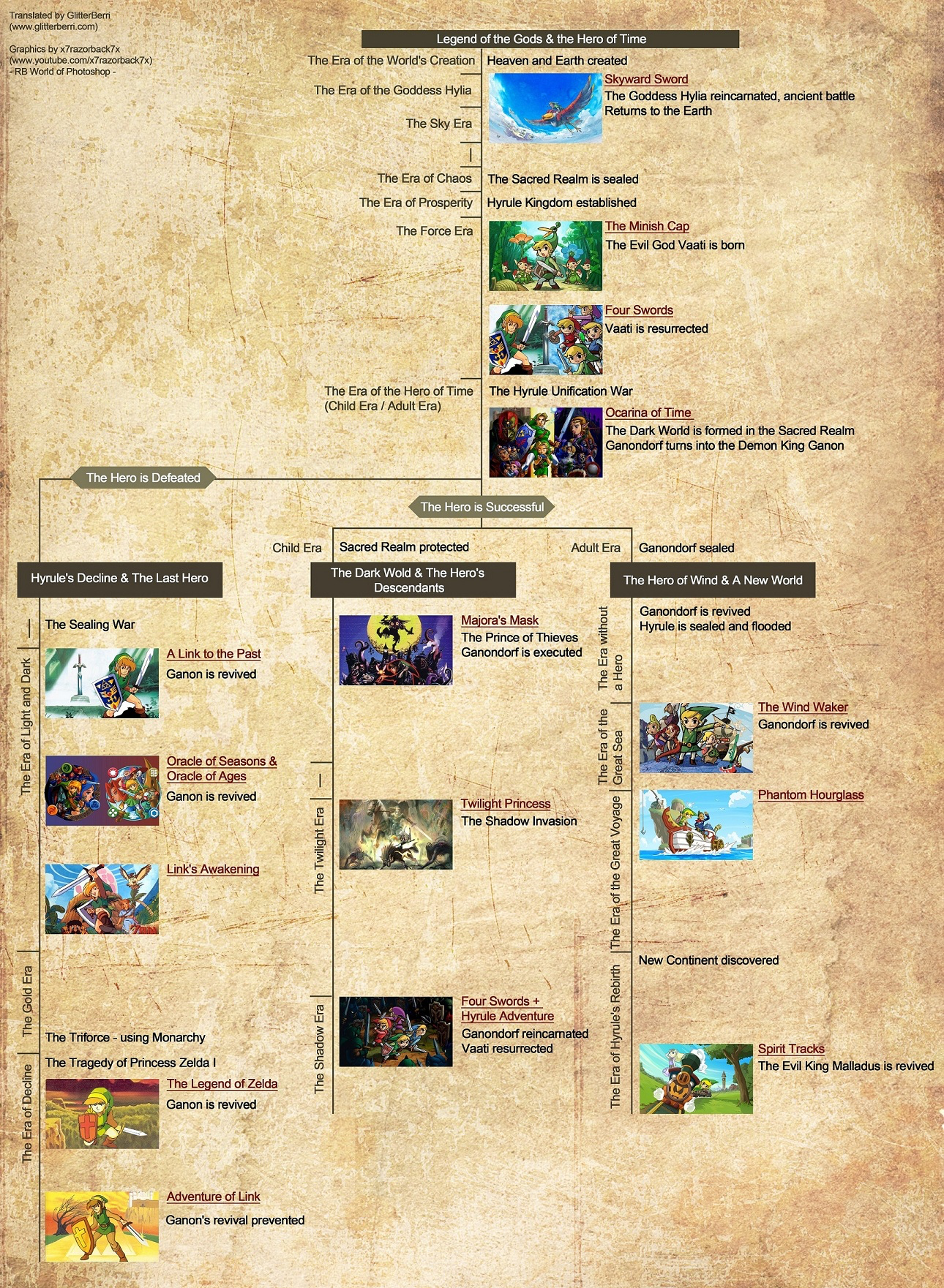
Going forward every fan asks where games fall in the official timeline. When Breath of the Wild came out, it was fun to speculate where the game fit. When Tears of the Kingdom came out, it became less fun because Nintendo doesn’t care or prioritize narratives or timelines or consistency between its games.34 It’s okay Nintendo doesn’t prioritize lore. In fact, it’s better, and I think that’s why they’ve lasted so long. They’ve never explained why Mario gets big when he eats a Super Mushroom. Nintendo lore is not Tolkien lore.
I love lore, and I love how things can be interpreted by many. But when rigid thinking happens, or when there’s no room for multiple possibilities or interpretations of characters, or when viewpoints are constrained, it becomes a problem for me. I think back to an interview with Sam Witwer, the voice of Maul from Star Wars: The Clone Wars and other animated series. The man knows his Star Wars. At some point, he was narrating an audiobook, I think depicting Maul, and the writers had depicted Maul in a different way than Witwer had imagined. So he called Dave Filoni to say he disagreed with how the character acted. Filoni told him, “Sam, it’s good if the stories are different… No, it doesn’t [have to be consistent]. These are all tall tales. And all of the tellings – it’s great if it’s a little bit different. That’s a reason to go seek that out, to get a different perspective on the same story.”5 I think that viewpoint and belief is a strong one, and so I’ve softened how I look at adaptations of characters, stories, or games.6
Finding Beauty in the Questions
It’s okay to not like things. It is okay to have your own head canon. Thank goodness for fanfic. But it’s most important to imagine and allow your interpretation of art to have a place in the world, unswayed by others. I would love for games to leave more to the imagination than explaining everything. Find beauty in the questions themselves.
- Originally released as Final Fantasy III on the SNES in North America. ↩
- Nintendo officially published the timeline in the 2011 art book Hyrule Historia, detailing a three-branch timeline split stemming from Ocarina of Time. ↩
- They barely acknowledge the Sheikah lore, and Calamity Ganon in Tears of the Kingdom. Nintendo didn’t want to alienate people that hadn’t played Breath of the Wild. But it was really weird considering how detailed the lore in Breath of the Wild was. ↩
- Series producer Eiji Aonuma has noted in Hyrule Historia that the developers prioritize gameplay innovation over strict adherence to timeline continuity. ↩
- https://www.youtube.com/shorts/lv1DdsXSYeM ↩
- Except Metroid: Other M; I still have strong opinions on that one. ↩
Leave a Reply